Make-A-Thon
NC State's annual sustainability innovation competition.
Think. Do. Make. Win.
Impactful ideation. Rapid prototyping. Real-world teamwork. That’s the NC State Make-A-Thon experience.
Make-A-Thon is NC State’s sustainability innovation competition. Collaborating in cross-disciplinary teams, students work to create the best solution to a sustainability challenge. Whether it’s about water, waste, energy, transportation or food — that’s up to each team to decide.
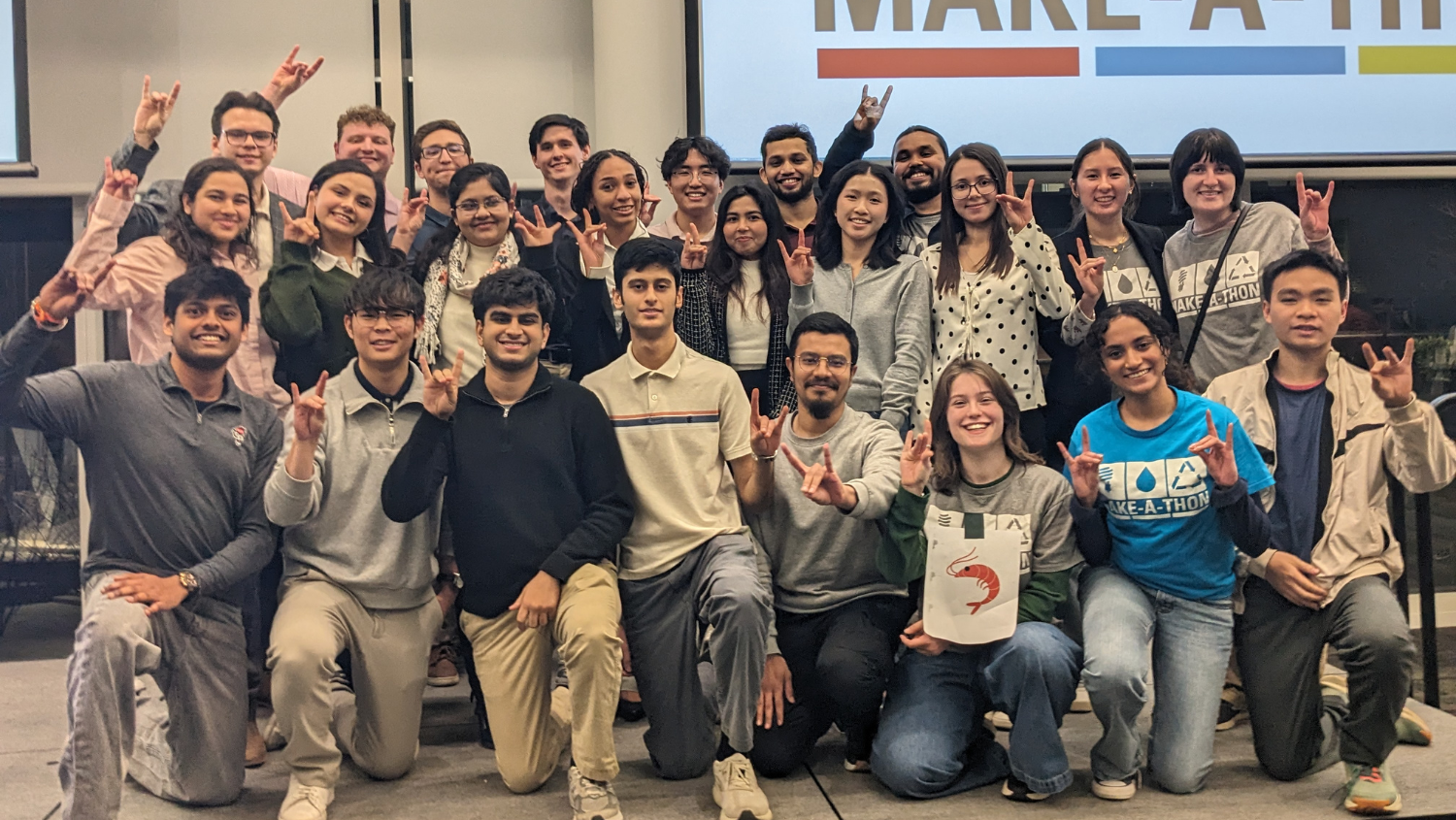
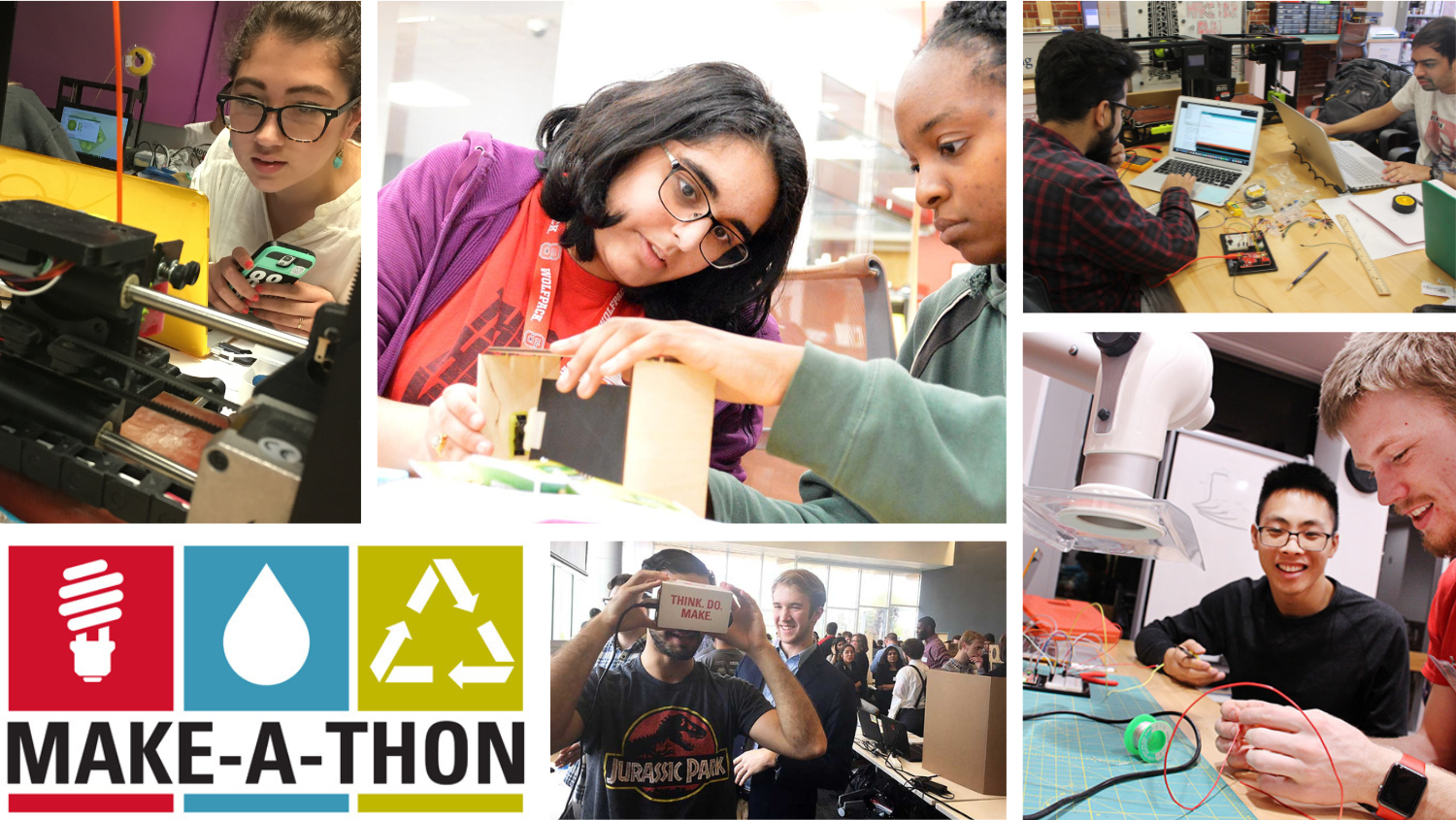

For 2026 Make-A-Thon, prize money totaled $10,250, including:
- 1st Place: $4,000 to Smart Sense
- 2nd Place: $2,000
- 3rd Place: $1,000
- $1,000 for Best Sustainable Design: Kirigami
- $500 for Best Textiles Solution
- $500 each to Best Prototype, Best Integration of Social Responsibility and Judges’ Choice
- $250 for Audience Favorite at the Make-A-Thon Finale
Beyond the prize money, Make-A-Thon offers valuable experience, professional connections and multiple other benefits that last long after the event ends.
Big ideas require bold thoughts that bridge perspectives. Full-time degree-seeking undergraduate and graduate students representing all NC State colleges are encouraged to apply.
FAQs
Who can participate in Make-A-Thon?
Make-A-Thon is open to all current, full-time, degree-seeking NC State undergraduate or graduate students. All students will compete as a team consisting of 4 members. At least two members of each team must represent separate colleges within NC State.
Students can register as an individual, partial team (2 students) or a complete team (4 students). Make-A-Thon staff will help individuals and partial teams find additional members to compete. Students can also utilize the Make-A-Thon Slack channel to find additional members.
I’m not an engineer. Does this matter?
No! You don’t have to be an engineer or a master of all things technology. Make-A-Thon has training sessions and mentors/experts on site to assist teams.
Artists, agriculturalists, designers, educators, engineers, conservationists, athletes, scientists, musicians, coders, writers, humanists, makers, marketers, managers, activists and more are needed to help make solutions that matter!
What skills do I need to have to participate in Make-A-Thon?
A Think and Do attitude is all that’s required. Make-A-Thon brings together students representing many backgrounds and skills. Bring whatever skills you have. Collaboration will take care of the rest.
What can I expect to happen if I register to compete at Make-A-Thon?
In the weeks leading up to Make-A-Thon, registered participants will receive their final team assignments and contact information. This allows participants to start getting to know each other before the competition starts on Thursday.
**For 2026, only 50 teams (for a total of 200 students) will be allowed to compete.** Confirmed registrations are based on a rolling basis.
After team check-in on Thursday, (one person is required to check in with staff), teams have the ability to meet, network and learn about sustainable innovation. They will also start the process of selecting what sustainability challenge they want to address and the scale of their solution’s impact- individual, campus, community, country or global.
For example, a team might choose to create a solution that focuses on water conservation. They could decide to create a widget that controls bathroom tap water, a public education campaign on responsible water use or an app that promotes water-efficient agriculture.
On Friday and Saturday, teams’ idea generation continues and prototyping begins. Mentors and experts from campus and the community will be onsite to answer questions, provide feedback and make the most of the resources available, including technology located in the Maker Spaces.
On Sunday, teams will finalize their prototypes and presentations. They will then pitch their solution to judges from the community and local companies. And, yes, there are prizes for the winning teams.
What type of prototype is expected at Make-A-Thon? I’ve never built anything before!
These are just some examples of prototypes:
- 3D design (printed, assembled, or built)
- Visual drawings
- Storyboard (to outline a process)
- Website landing page or visual design of a website
- Visual design of an app or app prototype
- A pamphlet, flyer or other advertisement that clearly illustrates the concept (helpful for non-profits)
- A slide deck that illustrates the design concept/solution (PPT, Google Slides, or any other tool)
- Video content filmed to capture the design/creation in action, if applicable
Check out Make-A-Thon’s previous winners for some inspiration!
When does it occur?
Make-A-Thon will be January 22-25, 2026. The winners will be announced at the awards ceremony on January 25.
Are there any fees involved?
No! Make-A-Thon is free to students. Your only commitment is time!
Are there prizes?
Yes! Prizes for 2026 total $10,250, including:
- Grand Prize: $4,000
- 2nd Prize: $2,000
- 3rd Prize: $1,000
- Best Sustainable Design- Kirigami: $1,000
- Best Prototype: $500
- Best Integration of Social Responsibility: $500
- Judges’ Choice Award: $500
- Best Use of Textiles: $500
- Audience Favorite: $250
How do I sign up?
Registration for Make-A-Thon 2027 will reopen on November 2, 2026. Sign up to be notified using this interest form.
What are the goals of Make-A-Thon?
Make-A-Thon is designed to get students involved in valuable learning experiences that make a difference. It promotes practices that are good for the environment and society while helping students solve real-world problems and work with others from different fields. Make-A-Thon offers guidance, timely feedback and opportunities for students to reflect on their learning. By doing this, Make-A-Thon aims to improve the skills that employers want, such as career planning, communication, critical thinking, leadership, professionalism, teamwork and technology..
2026 Schedule of Events
Make-A-Thon 2026 takes place Thursday, Jan. 22 – Sunday, Jan. 25.
This is NOT a lock-in event. Teams are not expected to remain on-site for the duration of the event.
Thursday, Jan. 22, Duke Energy Hall, Hunt Library
- Check-In, 3:30-5:00 p.m. (required, at least one member from each team must check in, pick up information packets, maker kits and t-shirts)
- Make-A-Thon Kickoff, 5:00-6:15 p.m.
- Gain a deeper understanding of sustainability, hear from a past winner and receive a clear overview of the Make-A-Thon experience.
- Speakers include:
- Matt Fox, director, NC State Social and Sustainable Innovation and Entrepreneurship
- Christopher Galik, deputy executive director, Climate and Sustainability Academy
- Nick Sischo, systems engineer, Cisco Systems, Inc., and Make-A-Thon Alumni
- Chess Miller, director, NC State University Housing Residential Learning
- Make-A-Thon Dinner with Teams, 6:30 p.m.
Friday, Jan. 23
Makerspaces and mentors will be available to support teams between 9:00 a.m. – 5:00 p.m. on Centennial Campus and in the Hodges Wood Products Lab.
- A full list of mentors, their expertise and availability will be provided to participating students at check-in.
- Mentors include campus, community and industry experts from across the nation.
Saturday, Jan. 24*
Makerspaces and mentors will be available to support teams between 9:00 a.m. – 3:30 p.m. virtually.
- A full list of mentors, their expertise and availability will be provided to participating students at check-in.
- Mentors include campus, community and industry experts from across the nation.
Sunday, Jan. 25*
- Deadline to submit team solution, 5:00 p.m. via virtual form (required)
Due to inclement weather, Saturday and Sunday schedules have changed to a virtual format.
Tuesday, Feb. 3
Judging will take place Jan. 25 – 27. The top 12-15 teams will be invited to pitch their solution in-person at Duke Energy Hall on Tuesday, Feb. 3, from 5:30 – 8:00 p.m..
2026 Make-A-Thon is brought to you by the following hosts:
NC State Make-A-Thon has been certified sustainable at the Champion Level.
Sponsorship is available at several tiers, detailed here. Contact [email protected] for more information.
Previous Winners
2026
GRAND PRIZE: Smart Sense, a Bluetooth-enabled system that automatically reduces dorm energy use when rooms are unoccupied.
Second Place: A washing machine filter designed to capture microfibers before they enter waterways.
Third Place: PackShare, a secure campus sharing app that keeps usable items circulating within the Wolfpack community.
Best Sustainable Design-Kiragami: Bugzu, a sustainable composite from invasive plants and seafood waste for outdoor applications.
Best Use of Textiles Award (1st): A washing machine filter designed to capture microfibers before they enter waterways.
Best Use of Textiles Award (2nd): Repurposes textile scraps into student-made lanyards through coursework and volunteer engagement.
Judges’ Choice (Tie): Smart Sense, a Bluetooth-enabled system that automatically reduces dorm energy use when rooms are unoccupied.
Judges’ Choice (Tie): PackShare, a secure campus sharing app that keeps usable items circulating within the Wolfpack community.
Best Prototype Award: TrashyMap, a community-mapped app that helps users locate nearby trash cans through verified, user-generated data.
Best Integration of Social Responsibility: A Kirigami-designed water-harvesting structure to collect and filter atmospheric water.
Audience Favorite: EcoLift, an event-based carpooling platform that fills empty vehicle seats to reduce single-occupancy travel.
Click here to read a summary of the submitted projects, and here to view the teams’ submitted slide deck. Read about the winning solution, Smart Sense, here.
2025
GRAND PRIZE: EcoPack, a campus app rewarding eco-friendly actions with points redeemable for rewards, while providing sustainability resources and engagement opportunities.
Second Place: Live water quality sensors to replace manual data collection, saving researchers time, energy, and resources while enhancing efficiency.
Third Place: A free-use bike rental system with One Card-operated locks and a point system rewarding sustainable transportation and maintenance participation.
Best Use of Textiles Award: Tail-er, a business upcycling textile waste into high-quality dog accessories while supporting the community through donations to animal shelters and job creation.
Judges’ Honorable Mention Award: Bounce Back: A campus initiative repurposing dead tennis balls into sound-dampening panels, combining sustainability with functionality for versatile noise-reduction solutions.
Best Prototype Award: Botanica, an app offering AI-powered access to science-backed, culturally inclusive traditional remedies, promoting natural wellness, sustainability, and cultural preservation.
Best Integration of Social Responsibility: SheSustain, an initiative creating biodegradable menstrual pads from campus-collected plant materials, distributed with smart disposal bins and a composting system.
Click here to read a summary of the submitted projects, and here to view the teams’ submitted slide deck. Click here to read about the winning solutions.
2024
GRAND PRIZE: The Tuffy Tumbler, a reusable cup with RFID technology that could be linked to a student’s dining account to enable the purchase of drink plans without the waste created by disposable cups.
Second Place: A process for cotton gin waste from the textile industry to be turned into a supplemental food option for cattle.
Third Place: AI-powered detection system that could be installed in campus dining halls to analyze the types of leftover food on returned plates, helping to establish patterns that could result in less food waste.
Best Use of Textiles Award: Long-term erosion control could be created from NC-grown hemp fibers and biomass waste instead of plastic. These wattles would embed pouches of native and local wildflowers, creating a biodegradable product.
Judges’ Choice Award: An app that gamifies plogging, which is jogging while picking up litter, and could result in a reduction of litter in a community.
Best Prototype Award: The creation of a zip-tie with dual-directional teeth results in a reusable product, which reduces plastic waste.
Best Integration of Social Responsibility: In Ghana, where many women don’t have access to clean feminine hygiene products, one of the country’s invasive plant species could be used to produce eco-friendly and non-toxic menstrual pads that would be available at distribution centers around the country.
Click here to read a summary of the submitted projects, and here to view the teams’ submitted slide deck. Click here to read about the winning solutions.
2023
GRAND PRIZE: Use of agricultural waste to produce magnetic biochar hydrogels to absorb contaminants from wastewater, such as organic chemicals and heavy metals. Spent hydrogels can also be reused for soil amendment.
Second Place: An online site named Pack Exchange that allows students to buy, sell, give and swap items they no longer use.
Third Place: A self-sanitizing, reusable cloth towel dispenser to reduce paper towel waste while providing an affordable and sanitary hand-drying experience.
The Wilson College of Textiles also offered a special textiles category and prizes to teams the following ideas:
- A machine that processes plastic bottles into thread, creating a sustainable fabric such as nylon
- Moss-based urinal cakes that are biodegradable and do not contain nor emit harmful chemicals while conserving water.
To see the awards ceremony please check the live stream replay here. Click here to read a summary of the submitted projects. Click here to read about the winning solutions.
2022
GRAND PRIZE: An Arduino-based device that can turn off lights in residence hall rooms when students are not present. Unlike a motion detector switch, the device offers an audible prompt to confirm no occupancy before lights are turned off.
Second Place: A showerhead that encourages shorter showers by briefly pausing flow of water after a set period of time as a reminder to conserve water.
Third Place: A network of UV light sanitation stations on campus where students can sanitize disposable masks to allow for reuse, which reduces mask waste.
2021
GRAND PRIZE: An app that connects grocery stores with food-based charities to reduce food waste. Grocery stores upload edible inventory that is set to be discarded so that food charities can recover the food for distribution in the community. This helps address both food waste and food insecurity issues.
Second Place: A self-contained mini water treatment plant that will allow rural communities to harvest rainwater and use surface water as a drinking water source. The product uses a centrifuge to separate heavy particles, a sand and gravel filter to separate fine particles, and a UV-C lamp to disinfect the filtered water.
Third Place: A network of smart composting bins on campus that collect data for waste management, as well as assist in the sorting of compostable waste. This data can be used to gamify the process of composting, encouraging students to compete with one another to see who can compost the most.
2020
GRAND PRIZE: Pack ‘N’ Bulk is a concept for a zero-packaging healthy grocery store on campus.
Second Prize: An in-home extruder and grinder that recycles and repurposes plastic by converting it to plastic filament.
Third prize: Forecasting software for dining halls that generates data about how quickly each food item is consumed so that food waste can be avoided.
2019
GRAND PRIZE: Imagine smart windows that adapt to the changing level of sunlight. In this energy-saving system, window shades and indoor lighting would automatically adjust to the sun, providing the optimal level of lighting for building occupants. The team won $2,000.
Second Prize: An Internet of Things-connected sensor could help save $300 a year in residential water use. A companion app challenges users to save water while Machine Learning helps identify water leaks before they become major water wasters.
Third prize: Recycling requires a market for the recycled material. If recycled plastic is integrated into a new type of pre-made concrete mix, this could reduce plastic waste while also simplifying the plastic recycling process.
2018
GRAND PRIZE: The team who won the grand prize used piezoelectricity to create floors that capture and store energy. Each member of the winning team received a Desktop 3-D Printer and Starter Kit.
Second Prize: An internet of things-enabled factory/office/home that uses sensors to determine how humans are interacting with the building
Third prize: A reusable cup program for campus, as well as a foldable cup prototype
Auotdesk Fusion 360 Prize: Use of enzymes to process plastic recyclables
Social Media Prize: Plant sensors that save water by eliminating unnecessary irrigation
Paradigm Innovation Dare To Shift Prizes: An internet of things-enabled factory/office/home that uses sensors to determine how humans are interacting with the building, a mobile app that improves efficiency of evening safety/security escorts on campus, a reusable coffee cup lid and campus cup share program
2017
GRAND PRIZE: The winning idea is for a bike-share program that uses existing campus bicycles and infrastructure.
Each member of the winning team received a Desktop 3-D Printer and Starter Kit. The team also wona consulting session with Aly Khalifa, NC State’s social entrepreneur in residence, and gift certificates for free fabric poster printing from Spoonflower.
2ND PLACE: The winning idea is a app-based surge protector for outlets that results in reduced phantom load.
Each member of the team received a SparkFun Tinker Kit, a $100 Shapeways 3D printing credit and a gift certificate to Spoonflower.
BUILT ON CLOUD PRIZE: The winning idea is a trash can attachment that notifies a user if a recyclable item is thrown away.
IBM donated $1,000 cash to best cognitive cloud solution that utilizes Bluemix.
FUSION 360 PRIZE: The winning idea is a modification to residence hall trash chutes that will accommodate recycling.
Autodesk donated Space Mouse and digital caliper for each member of team that best utilizes Fusion 360 design software.
SOCIAL MEDIA PRIZE: The winning team chronicled the development of a water-saving showerhead device.
The winning team received a smartphone bundle of cool prizes for best documenting their design journey
2016
GRAND PRIZE: KnowURShower reduces water and energy use associated with long showers
ENERGY PRIZE: ecopen, a door mechanism that generates energy as a door is opened
WATER PRIZE: Coliform No More, a reclaimed water storage tank that oscillates to prevent bacterial growth and lengthen the storage life of reclaimed water
WASTE PRIZE: Trashr, a sensor designed to optimize dumpster trash collection routes
FUSION 360 PRIZE: Step-Up Trash Compactor, which compacts trash or recycling using human power, and Internet of Things, an app that encourages sustainable behaviors