It Takes a Village: Uncovering Microbial Communities that Degrade Bioplastics

Our story begins on a North Carolina farm, with long rows of tomato plants stretching out across the fields. Laid over the soil of each row is a thin layer of plastic, added to retain moisture and suppress weed growth. Farmers have widely used these plastic mulch films since the 1950s to significantly increase agricultural output.
A modern mainstay of row crop farming, plastic mulch film is often made of conventional non-biodegradable plastic like polyethylene (PE), and according to a United Nations report on agricultural plastics, an estimated 2 million tons of plastics were used in agriculture globally in 2020. Even when the mulch films are removed, damage from the sun’s light, wear and tear from farm work, and impacts from the elements create smaller and smaller plastic pieces that persist in the soil for hundreds of years.
An alternative to conventional plastic mulch film is biodegradable plastic mulch film, which can be tilled directly into the field to biodegrade. However, the process through which the biodegradable film breaks down remains poorly understood.
Edeline Anthoniraj, a doctoral student in the Department of Plant and Microbial Biology at NC State University, seeks to investigate what happens to fragments of biodegradable plastic left in the soil and the role microbes play in helping break them down.

What are Biodegradable Plastics?
Biodegradable plastics can be made from plant-based materials or fossil fuels, and their chemical structure allows microorganisms to completely break them down. Anthoniraj’s research focuses on two widely used materials: polylactic acid (PLA) and polyhydroxyalkanoate (PHA).
Both PLA and PHA are used in agriculture, biodegradable packaging, as well as 3-D printing. They are also being explored for applications in medical devices. Both materials will biodegrade within proper waste management facilities, such as industrial composting, but outside of those facilities, their degradation slows, sometimes drastically.
“While we should be aiming to reduce the use of plastic all around the world, it is not always feasible or realistic,” Anthoniraj says. “Additionally, one way or another, plastic will make its way into the environment. Sometimes this is unintentional and other times, like with plastic mulch film, necessary. Biodegradable plastics would potentially be a solution and help alleviate the persistence of plastics overall, which is why understanding their impact in the natural environment is key.”
Anthoniraj, along with her advisor, Manuel Kleiner, associate professor in the Department of Plant and Microbial Biology, and research scholar Alfredo Blakeley-Ruiz, is collaborating on the project with researchers Miriam Weber, Christian Lott, Ann-Sophie Rupp and Victoria Eckerle at HYDRA Marine Sciences in Bühl, Germany. HYDRA Marine Sciences specializes in studying how biodegradable materials, including plastics, break down over time across different environments. Their experiments with PLA, PHA and other biodegradable plastics focus on agricultural soil, where mulch films are used, as well as marine and freshwater environments, where plastic pollution accumulates not only from land sources but also from intentional plastic use, such as fishing gear.
Regardless of the environment, microbes are responsible for breaking down biodegradable plastics. Anthoniraj’s work evaluates which microbes are present in a given environment, the cellular proteins responsible for breaking down the bioplastics, and the impact this process has on the surrounding environment.
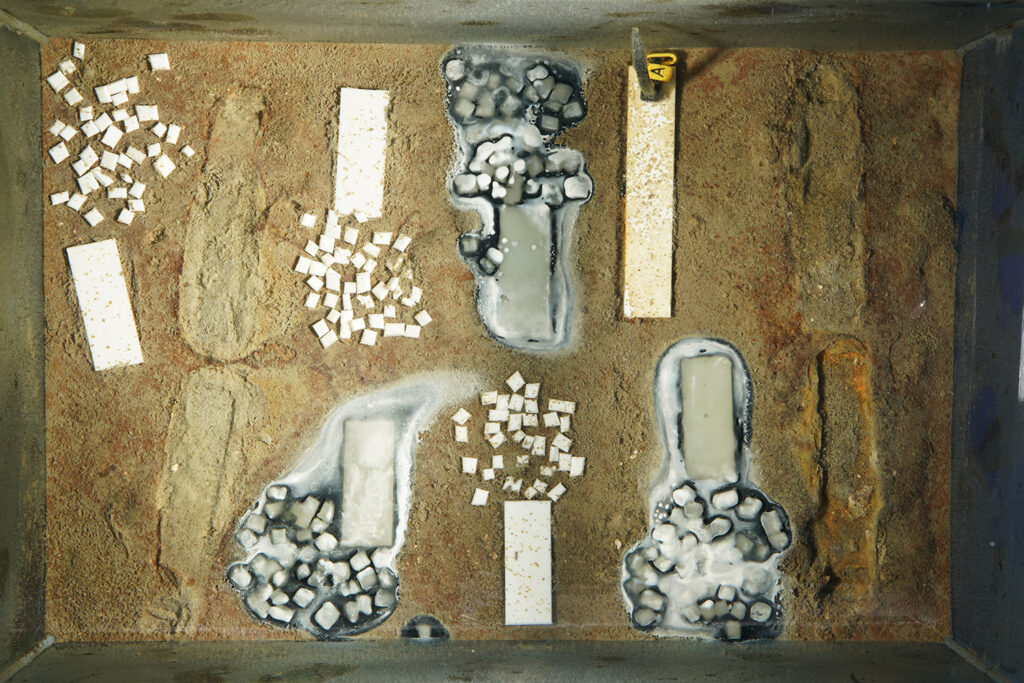
Impact of the Microbial Communities
Anthoniraj simulates different environmental conditions in the lab to track how biodegradable plastics break down over time. At specific intervals, she samples the microbial communities on the bioplastics for environmental DNA and protein sequencing to understand which microbes are present and which proteins are being expressed. Sampling will continue until the plastics are completely broken down, which has already occurred with the PHAs.
With this data, Anthoniraj can examine the microbial community as a whole, as well as how different species interact and the ways in which the microbial community’s metabolism responds to environmental factors and changes over time.
“From our data, we found that the microbial community completely shifted from year one to year four,” Anthoniraj says. “Interestingly, the materials with a shared chemical composition also have shared microbial communities and similar protein expression patterns. We also saw that biodegradation is limited by access to nitrogen and phosphorus.”
Work is ongoing to identify which enzymes, both known and new, are able to break down bioplastics in the environment.
As for the farm’s plastic mulch film, “it’s possible that we could design inoculants for agricultural systems where, if you introduce that, that could help prevent microplastic accumulation,” Anthoniraj shares. “Overall, the hope is that through this research, we can make more informed decisions on which biodegradable plastics are best suited for different applications with the least negative environmental effects.”
This post was originally published in College of Agriculture and Life Sciences News.